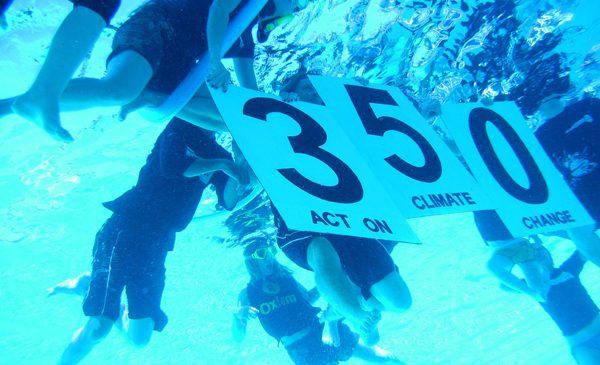
As sea levels rise, ten humanitarian and environmental groups in Western Australia combined forces this past weekend and called on the Australian Government to take the plunge and go below 350.
Launching the 10-10-10 global week of action on climate change, more than 7300 other events are underway in 188 countries during this week in the largest ever global demonstration on climate change.
To draw attention to this global movement, Oxfam Australia and World Vision came together with WWF-Australia, Tear, The Oaktree Foundation, The One World Centre, The Conservation Council, Save Our Marine Life, Environment House and the Anti-Nuclear Association of WA.
The 5 humanitarian and 5 environmental agencies dived with signs bearing the numbers 3, 5 and 0 which combine to make up the number 350, the maximum level of atmospheric carbon in parts per million (ppm) that scientists say is the upper limit to ensure climate safety. The current global level is 390ppm and rising, and carbon levels must take a dive to stop the catastrophic effects of climate change.
Droughts, floods and storms are causing havoc with people’s ability to grow food which is seeing lives and livelihoods being destroyed in poor countries. These countries have not caused the problem and do not have the financial resources to adapt are suffering most.
It is crucial that rich countries help by reducing their emissions to bring atmospheric carbon levels below 350ppm, as well as supporting projects to help communities adapt to the devastating impacts of climate change.
We know that runaway climate change will imperil coral reefs and forests, and habitats across the planet, accelerating extinctions. For the sake of people and nature, we need national and international action, including a price on carbon.
- To find a 10/10/10 event near you, visit www.350.org.
- Check out more photos from our underwater stunt here.