As the third anniversary of the Syria crisis approaches, it is impossible not to be affected by the plight of millions of children caught in the cross-fire, fleeing with families or beginning their lives as refugees in Syria’s neighbouring countries.
The devastating impact of the conflict weighs heavily on parents. Hamdo, who comes from a town near Damascus but now lives in a small flat in Baaqa, Jordan, said: “I left Syria because of the children. They were suffering both physically and mentally – whenever they heard planes and trucks they were terrified and they would scream. When they arrived in Jordan they were still scared of loud noises — they thought they heard gunfire. My little daughter who is now six remembers our home; she cries all the time and even though we left when she was four she still remembers her toys and the children she used to play with.”
Hamdo worries what future his children have ahead of them.
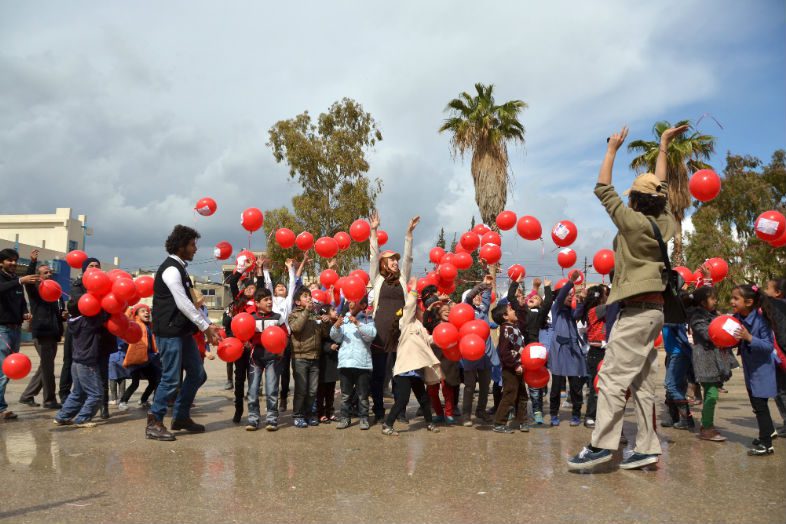
Every child has hopes and dreams. A group of 70 Syrian and Jordanian children who came together at a school in Baqaa pasted illustrations of theirs onto red balloons that were released in the sky— to mark the beginning of a week of vigils taking place around the world in solidarity with people affected by the Syria crisis. With boundless energy they chased the balloons around the playground together.
“I dream of peace” is what twelve-year-old Yasmin wrote on her balloon. She arrived in Jordan a year and a half ago from the Syrian city of Daraa and hopes to go back to Syria to one day study to become a doctor.
The children and their teachers talked about the support and generosity that Jordanian families have shown to the refugees.
Ismail, a 10-year-old Jordanian child, said: “I hope that my [Syrian] friends’ country will go back to the way it used to be. We always like to help our Syrian neighbours. The other day we gave them a cupboard, and my dad helped them roll out the carpet, we also gave them some clothes to wear.”
But everyone is getting tired of waiting. It is time for world leaders to put the children of Syria first and ensure that they have a future to return to. Governments must push the parties to the conflict to end the bloodshed, and ensure all those in need of life-saving aid can access it and commit to inclusive peace talks.
As people come together this week to hold vigils around the world, from London to Hong Kong, and Darfur to Za’atari refugee camp in Jordan, the hopes of Syrian children will be shared by millions of others.
RSVP to the Melbourne vigil on Facebook and invite your friends.
EVENT DETAILS:
Friday 14 March 2014
Federation Square, Main Stage (Corner Swanston and Flinders Sts, Melbourne)
7.30-8.30pm
GUEST SPEAKERS:
Helen Szoke (CEO, Oxfam Australia)
Anthea Spinks (Humanitarian and Emergency Affairs Manager, World Vision)
LIVE MUSIC:
Adnaan Baraky – Syrian Composer and Oud Player
HOLD YOUR OWN VIGIL:
If you’re unable to make the vigil in Melbourne, find out how to hold your own vigil or participate in the global e-vigil on Friday 14 March.
2.5 million people are living as refugees, you can help keep them safe.