What does climate change mean?
“We don’t really call it climate change,” a workmate tells me, “but wet season is shorter and the weather more variable. It’s very difficult for rice farmers.”
On every field trip, these words are echoed by farmers explaining the challenges of growing enough rice. Nearing the end of August, wet season is barely a trickle in many provinces—whereas the season used to start in June. Normally lush rice fields are still waiting for the new rice crop. Without irrigation, most farmers rely entirely on rainfall to grow rice and other crops. Forget the technicalities of climate change, consider the immediate impact: less rain = lower rice yields = not enough food.
Climate change is no longer about long-term projections; it’s not some abstract thing that might happen in the future. It’s a very tangible issue that’s causing problems right now. Last year, Cambodia had floods from Typhoon Ketsana, followed by drought for a month in some provinces. These major fluctuations are devastating for rice crops and subsistence livelihoods. It’s an enormous challenge to deal with, but it’s not all doom and gloom.
Adapting to the change
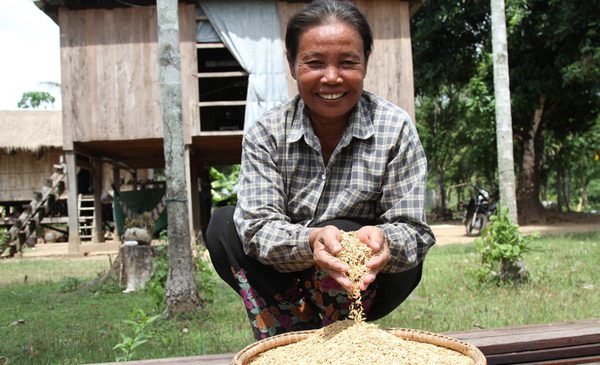
In Cambodia, Oxfam is providing training on the System of Rice Intensification (SRI). SRI requires no chemicals, grows quicker than traditional rice varieties and uses a fraction of the water. These last two features are vital for increasingly short wet seasons and volatile weather. SRI is not just good for adaptation; it also increases yields dramatically, as Phit Nary explains to me.
“In the same plot of land we now get 3000kg of rice in one season, instead of 1000kg. I have sold about 600kg of excess rice. From this income, I have spent it on a water pump, clothes, books and pens for my daughter’s study. I also use the money to send my daughter to school from 2003 because we now have enough money and enough food for the whole family to eat.”
Adaptation, such as SRI, can only work in some areas because the system cannot handle low level flooding that occurs naturally in many parts of Cambodia. For the majority of farmers, climate change still means a simple equation: less rain = less food.
More than a moral challenge, acting to reduce the impacts of climate change is a moral obligation.