Part two
I’ve just returned from visiting tiny Pon Chea village where we began making our film about water, sanitation and hygiene (WASH). It’s really removed and remote, and a difficult location because the people here are so poor. However, the potential for improving people’s lives is amazing and that’s why Oxfam is here.
The village
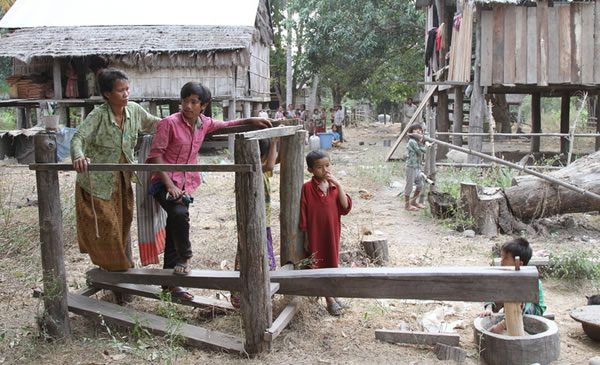
Set on the Mekong River in Kratie province, Pon Chea village is many hours from the nearest town and nearly inaccessible during wet season. This remoteness means minimal access to healthcare, very limited infrastructure and isolation from livelihood opportunities in Cambodia. Pon Chea has only had a school for a couple years, and it was Oxfam who worked with the community to build one. Villagers are of the Phnong ethnic minority, which means they are further marginalized from mainstream Cambodia.
Water and sanitation challenges
For water, a few villagers had clay jars for storing water, while most families would collect water from the Mekong. This water is not safe to drink so families would have to boil it or just get sick. For sanitation, Pon Chea’s only toilet was at the new school. Otherwise, it’s off to the jungle with mosquitoes, spiders, snakes and no privacy. Hygiene was not good because families are unaware of modern practices and unable to buy basics, like soap. Water, sanitation and hygiene (WASH), which is essential for good health, were all severely lacking.
All of these factors create a situation where a WASH project is very challenging to implement effectively and sustainably.
Food and income
Adequate water and sanitation are not the only problems for the people of Pon Chea. As with most of Cambodia, villagers here rely on subsistence rice farming, which is dependent on consistent wet and dry seasons — yet these seasons are increasingly volatile. Irrigation or even a basic motorised water pump is non-existent. Plowing the fields is done by hand, although some families have a buffalo to help. Traditional rice-growing techniques lead to small crops. After harvest, rice is milled manually — there are no motorised mills in Pon Chea.
The result is not enough rice to eat for the entire year. In a village where rice is the main source of food — sometimes supplemented with home-grown vegetables, fish from the Mekong or occasionally some other meat — meeting daily nutritional requirements for any family is a constant challenge.
For filming, most other villages would be much easier, but we chose to film in Pon Chea because we wanted to give the poorest and least represented people a chance to tell their story.